

How to Care for Porous Commercial Tile and Grout
Last Updated: November 19, 2026
Quick Summary
Cleaning solutions for porous commercial tile must be matched to the surface's absorbency, applied at the label's dilution, given the label's dwell time, and rinsed thoroughly. A pH-neutral cleaner is the safe default for daily maintenance, while a mildly alkaline degreaser suits food-service floors and quarry tile but needs complete rinsing to avoid residue.
- Confirm tile and grout type with a water-drop test before selecting any cleaner.
- Avoid acidic cleaners such as vinegar and lemon juice on cement grout and most stone tiles.
- Deep cleaning is a sequence: dry removal, dwell time, agitation, low-moisture extraction, then full drying.
- Porous tile and cement grout stay damp longer, so build drying time into the closure schedule.
- Sealing may slow absorption on cement grout and absorbent stone but does not waterproof a floor.
Table of Contents
- Why Porous Commercial Tile Needs Different Cleaning Solutions
- Identify Your Tile and Grout Before Choosing a Cleaner
- What to Look for in the Best Cleaner for Porous Tile
- Deep Cleaning Commercial Tile Floors: What the Process Involves
- Tile and Grout Sealing: When It Helps and When It Doesn't
- Routine Maintenance vs. Professional Deep Cleaning
- Request a Tile and Grout Walkthrough for Your Facility
- Frequently Asked Questions
Why Porous Commercial Tile Needs Different Cleaning Solutions
Cleaning solutions for porous commercial tile must reach into the surface without leaving residue, the difference between a floor that looks clean for an hour and one that stays presentable through a week of foot traffic.
A professional evaluation of floor type and condition comes before any service recommendation, because the wrong product on the wrong surface creates work instead of removing it.
Ceramic, quarry, and stone tile each absorb liquids at different rates, and grout absorbs faster than any of them.
How Porous Tile and Grout Trap Soil
Porous tile surfaces carry microscopic openings that hold liquid and suspended particles. Once soil settles in, a mop pushes it around rather than lifting it out. Cement-based grout is the worst offender: grease and dark liquids wick inward, and over months that buildup reads as discoloration rather than surface dirt.
Why Routine Mopping Can Leave Grout Looking Dirty
Mopping with too much water and too little rinsing leaves a detergent film that attracts soil. The floor may look acceptable when wet and dull or streaked once dry. If your floors still look dirty after cleaning, the cause is often residue, worn finish, or embedded soil rather than a lack of effort. Our guide on why your floors still look dirty after cleaning and how to fix it walks through the common causes.
Identify Your Tile and Grout Before Choosing a Cleaner
The first step in any tile program is material identification, not product selection. Porous commercial tile includes unglazed quarry tile, many natural stone tiles, and certain textured ceramic bodies; glazed ceramic and porcelain are far less absorbent.
A simple field check: place a few drops of water on an inconspicuous area and watch for several minutes. If the water darkens the surface or disappears, the material is absorbent and needs a gentler, residue-free approach.
| Surface |
Absorbency |
Maintenance Implication |
|---|---|---|
| Quarry tile |
High |
Needs low-moisture cleaning and periodic deep extraction |
| Natural stone tile |
Varies, often high |
Requires pH-appropriate products and care with sealers |
| Textured ceramic |
Moderate |
Soil lodges in texture; agitation matters more than chemistry |
| Glazed ceramic/porcelain |
Low |
Routine damp mopping usually sufficient |
| Cement grout |
High |
Absorbs stains; benefits most from sealing when appropriate |
| Epoxy grout |
Low |
Resists staining; avoid aggressive abrasives |
What to Look for in the Best Cleaner for Porous Tile
The best cleaner for porous tile is matched to the surface's absorbency, applied at the label's dilution, given the label's dwell time, and rinsed thoroughly.
Surface compatibility comes first. Abrasive cleaners, steel wool, and harsh scouring pads scratch glazed and polished surfaces and dull stone. On textured tile, mechanical agitation with a soft brush does more useful work than a stronger chemical.
Suitable and Unsuitable Ingredients
A practical way to sort products is by what they are asked to do, not by brand:
- Suitable for routine porous-tile care: pH-neutral floor cleaners, mild alkaline degreasers used at label dilution, and oxygen-based (percarbonate) stain lifters on colorfast surfaces. These lift light soil and grease without attacking the tile body or leaving a sticky film.
- Use with caution: high-alkaline degreasers on natural stone and on any floor with a sealer, because repeated use can strip the sealer and dull the surface; solvent-heavy products in enclosed food-service areas, because of odor and residue.
- Avoid: acidic cleaners such as vinegar and lemon juice on cement grout and most stone tiles, because they etch the surface and worsen discoloration; abrasive powders, steel wool, and scouring pads on glazed, polished, or sealed surfaces; and any product whose label warns against use on your specific tile or grout type.
pH-Neutral vs. Mildly Alkaline Cleaners
A pH-neutral cleaner is the safe default for most porous surfaces and daily maintenance, since it lifts light soil without attacking the material or leaving a film. A mildly alkaline cleaner cuts grease and heavy soil better, which suits food-service floors and quarry tile, but it needs complete rinsing to avoid residue. Strong acids are a poor choice on cement grout and many stone tiles; they can etch the surface and worsen the problem.
Dilution, Dwell Time and Rinsing
- Measure, don't eyeball. "A splash" is how residue problems start.
- Respect dwell time in both directions. Too short and the cleaner does nothing; too long and it can dry on the surface and leave a haze harder to remove than the original soil.
- Rinse in clean water, and change it often. A dirty rinse bucket redistributes the soil you just lifted. On porous tile, a second rinse pass is often the difference between a floor that stays clean for a week and one that looks dull by morning.
Matching the Product to the Tile Type
The same cleaner can be correct on one floor and wrong on the next. A quick reference for the surfaces most common in commercial facilities:
| Surface |
Absorbency |
Cleaner approach |
|---|---|---|
| Quarry tile |
High |
Mild alkaline degreaser at label dilution, low-moisture agitation, full rinse |
| Natural stone tile |
Varies, often high |
pH-neutral or stone-specific product; avoid acids and high-alkaline degreasers |
| Textured ceramic |
Moderate |
Neutral cleaner plus soft-brush agitation; texture holds soil, so agitation matters more than chemistry |
| Glazed ceramic/porcelain |
Low |
Routine damp mopping with neutral cleaner is usually sufficient |
| Cement grout |
High |
Neutral or mild alkaline cleaner with dwell time; oxygen-based lifter for stains on colorfast grout |
| Epoxy grout |
Low |
Neutral cleaner; avoid aggressive abrasives and strong solvents |
Deep Cleaning Commercial Tile Floors: What the Process Involves
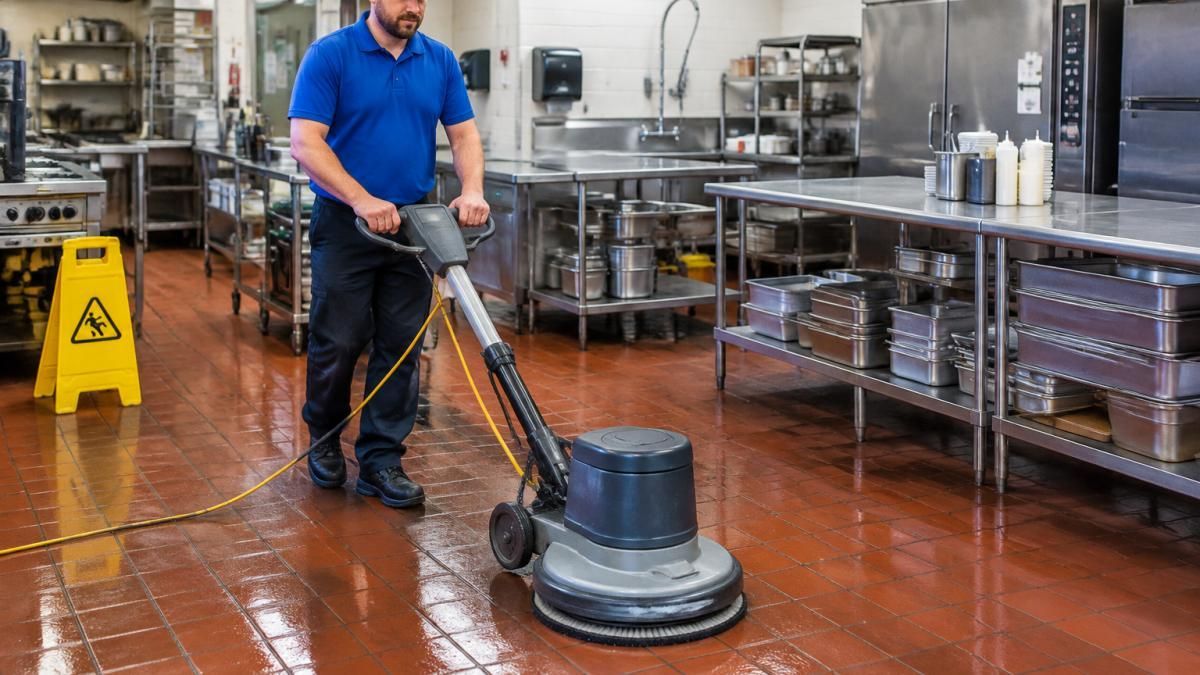
Deep cleaning commercial tile floors is a sequence, not a single pass. The goal is to remove embedded soil and old residue without driving either deeper into the surface.
(/commercial-cleaning-blog/how-to-remove-stubborn-stains-from-tile-and-grout) covers specific stain types in more detail.
Realistic expectations matter here. Some staining, particularly from long-term absorption, may lighten without fully disappearing. Restoration can improve appearance and hygiene, but it may not return aged grout to a factory-new look.
Tile and Grout Sealing: When It Helps and When It Doesn't
Sealing may slow liquid absorption in some cases; it does not waterproof a floor or make maintenance unnecessary. A penetrating sealer may be appropriate on cement grout and absorbent stone in high-traffic areas, depending on the surface and condition.
| Sealing Method |
Best For |
Limitations |
|---|---|---|
| Penetrating sealer |
Cement grout, absorbent stone |
Needs reapplication as wear occurs; not a barrier coating |
| Topical coating |
Some quarry and VCT-adjacent surfaces |
Can wear unevenly and trap moisture if applied over damp tile |
| No sealer |
Dense porcelain, epoxy grout |
Requires disciplined routine cleaning instead |
Testing any sealer on a small area first and applying it only to clean, dry tile is a common precaution, and sealing may need periodic reassessment. If you are weighing whether restoration is worth it, review the tile surface restoration service we provide and what it involves.
Routine Maintenance vs. Professional Deep Cleaning
Routine work protects a floor; professional deep cleaning resets it. Most facilities need both, on different schedules.
| Factor |
Routine Maintenance |
Professional Deep Cleaning |
|---|---|---|
| Frequency |
Daily to weekly |
Periodic, based on traffic and condition |
| Method |
Dust mopping, damp mopping, spot cleaning |
Pre-treatment, agitation, low-moisture extraction, rinsing |
| Removes |
Surface soil, fresh spills |
Embedded soil, residue, grout discoloration |
| Equipment |
Mops, buckets, soft brushes |
Scrubbers, extraction equipment |
| Typical trigger |
Scheduled program |
Visible dullness, staining, failed spot cleaning |
If you are deciding whether in-house work is still enough, our article on when routine cleaning isn't enough explains the signals that point to professional service. A floor that looks worse each month despite consistent mopping is telling you the routine has hit its ceiling.
Request a Tile and Grout Walkthrough for Your Facility
A walkthrough removes guesswork by identifying the tile and grout material and assessing condition before recommending a service.
A Smarter Clean combines recurring commercial janitorial service with specialized floor care in one vendor. If you are ready to compare providers, our commercial floor cleaning buyer's guide covers what to ask before signing.
Most facilities do not have a cleaning problem. They have a surface-matching problem, and it compounds quietly until the floor looks worn out.
Frequently Asked Questions
What is the best cleaner for porous tile?
There is no single answer for every floor. The right cleaner depends on the tile material, the grout, and what is embedded in the surface. A professional can evaluate your floor and recommend an appropriate maintenance approach for your tile and grout.
Why does grout look dirty after mopping?
Mopping often pushes soil into grout lines rather than lifting it out. Porous grout absorbs dirt, grease, and residue, so a damp mop can spread a thin film that dries dull. If the mop water is dirty or the cleaner leaves residue, the grout looks worse. Deep cleaning with the right dilution, dwell time, and a clean rinse water bucket usually makes a bigger difference than scrubbing harder.
Can porous tile and grout be sealed?
Sealing can help some porous tile and grout by slowing moisture and soil absorption, but it is not a guarantee of waterproofing or permanent protection. The surface must be clean and dry before sealing, and some tile types should not be sealed at all. A professional should identify the material and test a small area first. Resealing may be needed over time depending on traffic and cleaning products used.
How often should commercial tile and grout be professionally cleaned?
Frequency depends on traffic, spills, and the type of facility. High-traffic areas like entrances, restrooms, and food-service floors may need professional deep cleaning more often than offices or classrooms. Routine damp mopping and prompt spill cleanup between visits protect the surface. A walkthrough can help set a schedule based on your floor condition and cleaning frequency rather than a one-size-fits-all calendar.