

Routine Janitorial Cleaning vs. Clinical Disinfection in Dental Offices
Last Updated: October 25, 2026
Quick Summary
Clinical disinfection covers patient-care surfaces and instruments and is performed by trained dental staff, while routine janitorial cleaning handles non-clinical areas like waiting rooms, restrooms, and floors. Keeping these two jobs separate protects patients and gives each side the right products and training.
- Clinical staff disinfect operatories between every patient and handle all instrument processing and sterilization.
- Janitorial crews clean waiting rooms, reception, restrooms, break rooms, entrances, and all commercial floors.
- If a surface touches a patient, an instrument, or a clinical workflow, it belongs to clinical staff.
- Operatory floors are janitorial, but clinical staff contain spills of clinical material first.
- Build the floor care calendar around patient hours before fitting recurring janitorial visits.
Table of Contents
- Where Routine Janitorial Ends and Clinical Disinfection Begins
- Routine Janitorial Cleaning vs Clinical Disinfection: Side-by-Side
- Dental Office Infection Control Procedures Belong to Clinical Staff
- Your Dental Office Cleaning Checklist for Non-Clinical Areas
- Dental Office Floor Maintenance That Keeps Your Practice Looking Professional
- What Commercial Cleaning for Dental Offices Should Include
- Verifying the Work: Contact Times, Label Compliance, and Audits
- Request a Walkthrough and Cleaning Estimate for Your Practice
- Frequently Asked Questions
Where Routine Janitorial Ends and Clinical Disinfection Begins
Clinical disinfection in dental practices is the set of procedures clinical staff perform on patient-care surfaces and instruments to break the chain of infection between patients. Routine janitorial cleaning keeps the rest of the building clean, safe, and professional.
The stakes are higher than a smudged reception desk. The dental infection-control products market is forecast to reach USD 2,398.8 million by 2036 at a 6.3% compound annual growth rate, according to Fact.MR's dental infection control products market forecast, which tells you how seriously practices are investing in the clinical side.
Below, we break down exactly who does what, where the boundary sits, and how to build a cleaning schedule that holds up.
Routine Janitorial Cleaning vs Clinical Disinfection: Side-by-Side
The simplest way to see the split is to compare scope, who performs each task, and what each one is meant to achieve, what products are involved, who is trained to use them, and when each job happens.
The Five Dimensions That Separate the Two Jobs
| Dimension |
Routine Janitorial Cleaning |
Clinical Disinfection |
|---|---|---|
| Purpose |
Remove soil, dust, and visible contamination; protect the building and its finishes; present a professional environment |
Break the chain of infection between patients by reducing bioburden on patient-care surfaces and instruments |
| Scope |
Non-clinical zones: waiting rooms, reception, hallways, break rooms, restrooms, entrances, common areas, and commercial floors |
Operatory surfaces, dental chairs, delivery units, bracket trays, light handles, instrument processing, and sterilization |
| Products |
General-purpose cleaners, neutral floor cleaners, floor finish and stripper, encapsulation carpet chemistry, tile and grout cleaner, microfiber |
EPA-registered hospital-grade disinfectants, sterilants, enzymatic instrument cleaners, barriers, and single-use items |
| Who performs it |
Trained commercial cleaning staff |
Dental health care personnel with training in infection-control procedures |
| Timing |
Recurring scheduled visits, nightly, weekly, monthly, quarterly, planned around patient hours |
Between every patient, at the start and end of each day, and per the practice's written infection-control protocol |
What Each Side Is Responsible For
Routine janitorial cleaning covers the building envelope: floors, waiting-room furniture, restroom fixtures, break-room surfaces, entry glass, and wastebaskets in non-clinical zones. Clinical disinfection covers the operatory: dental chairs, delivery units, bracket trays, light handles, and instrument processing.
| Task Area |
Routine Janitorial |
Clinical Disinfection |
|---|---|---|
| Waiting room, reception, hallways |
Yes |
No |
| Restrooms and break rooms |
Yes |
No |
| Operatory surfaces and dental chair |
No |
Yes |
| Instrument cleaning and sterilization |
No |
Yes |
| Floor care: VCT, LVT/LVP, carpet, tile |
Yes |
No |
| High-touch clinical items and barriers |
No |
Yes |
The line matters because a 2025 review in Sterilization and Disinfection: Ensuring Infection Control in Dentistry describes cleaning as a required step before disinfection, specifically to remove organic matter that can interfere with the disinfectant.
Where the Boundary Gets Blurry, and How to Settle It
Three areas cause most of the confusion in real practices:
- The dental chair and delivery unit. These are clinical surfaces. Even the base and upholstery are cleaned and disinfected by clinical staff per the practice's protocol, not by the janitorial crew.
- The floor of the operatory. The floor itself is a janitorial surface, but spills of clinical material are a clinical-staff responsibility to contain and manage before routine cleaning resumes.
- The instrument-processing area. Counters and sinks in this room may look like ordinary surfaces, but they sit inside the clinical workflow. Treat them as clinical unless the practice's written protocol says otherwise.
The practical rule: if a surface touches a patient, an instrument, or a clinical workflow, it belongs to clinical staff. If it touches the building, the furniture, or the public, it belongs to janitorial.
Why the Split Protects the Practice
Separating the two jobs protects the practice in three ways. It keeps clinical staff focused on patient care instead of building maintenance. It gives the practice a written record of who is responsible for what, which matters when an inspector or a patient asks. And it lets each side use the products and training appropriate to its work, general cleaners on building finishes, EPA-registered disinfectants on patient-care surfaces.
Dental Office Infection Control Procedures Belong to Clinical Staff
Dental office infection control procedures are the written protocols a practice follows to prevent cross-contamination between patients, and they belong to trained clinical personnel, not to a janitorial crew. That is not a knock on janitorial teams. It is how the guidance is structured.
Why the CDC Assigns These Tasks to Trained Dental Personnel
The CDC's summary on dental sterilization and disinfection states that equipment cleaning, disinfection, and sterilization should be assigned to dental health care personnel with training in those procedures. The reason is straightforward: instrument processing, autoclave monitoring, and surface disinfection all require judgment about bioburden, contact time, and PPE that a general cleaning crew is not trained for. For a closer look at OSHA and infection-control considerations for dental offices, see our dedicated article.
Your Dental Office Cleaning Checklist for Non-Clinical Areas
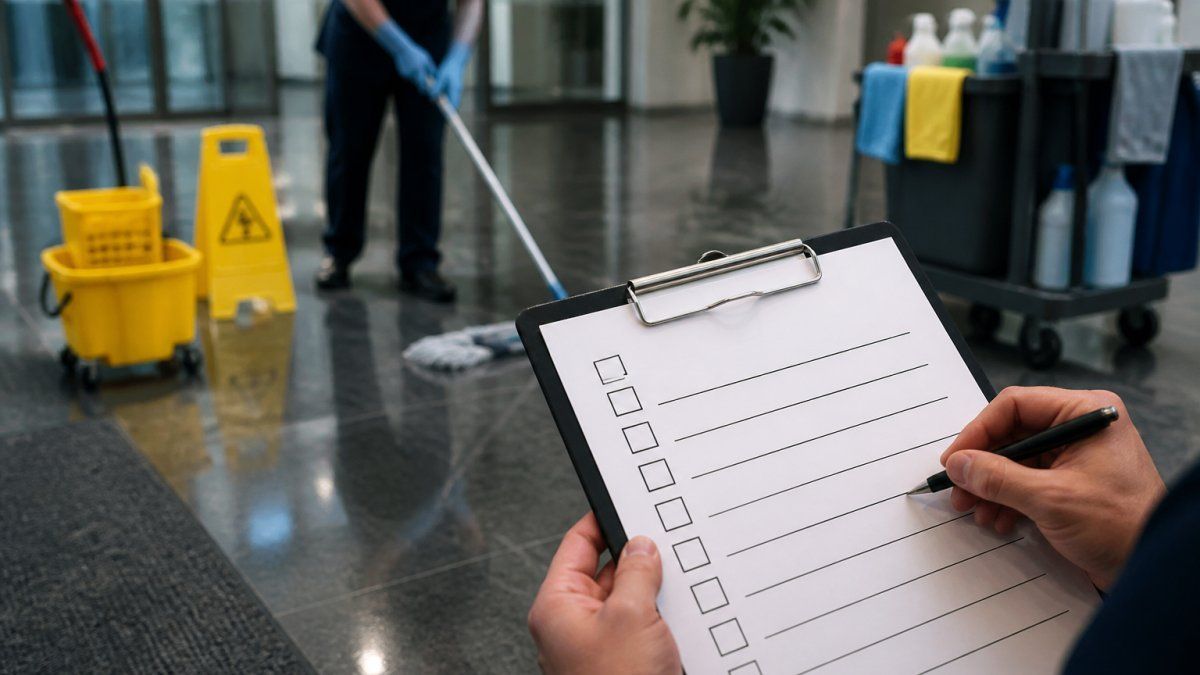
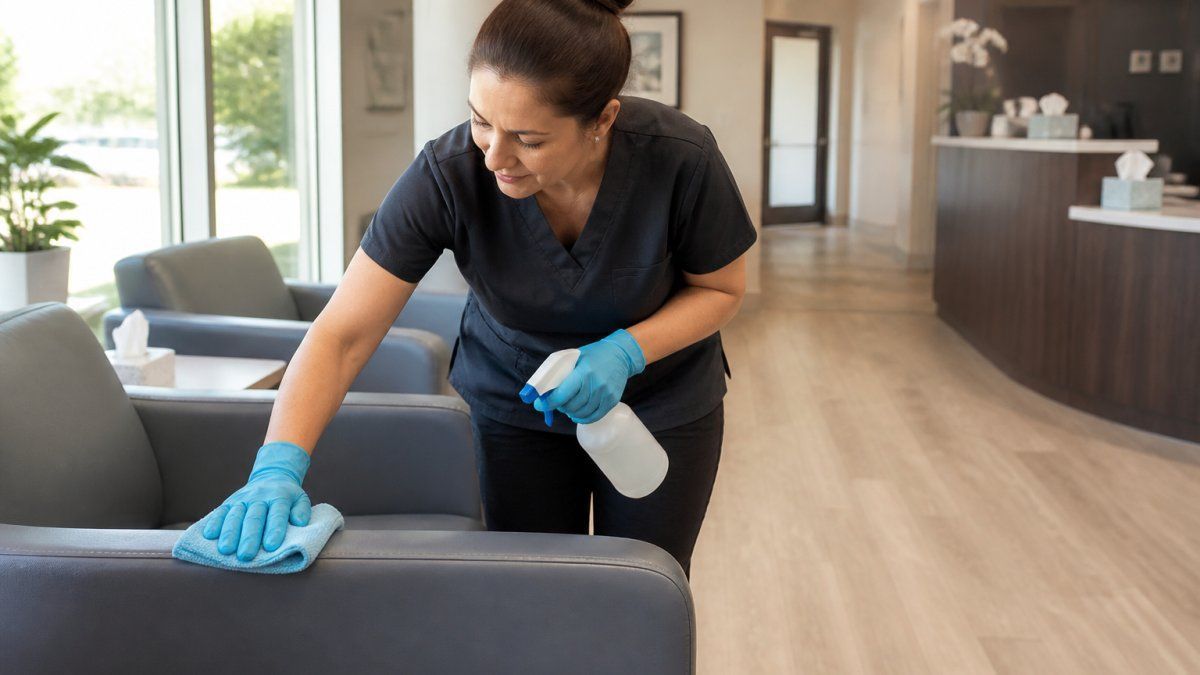
A dental office cleaning checklist for the non-clinical side should cover every room a patient or staff member touches outside the operatory, with a stated frequency for each. Here is the framework we use.
Room-by-Room Task Matrix and Frequency Schedule
| Area |
Daily |
Weekly |
Monthly or Quarterly |
|---|---|---|---|
| Waiting room |
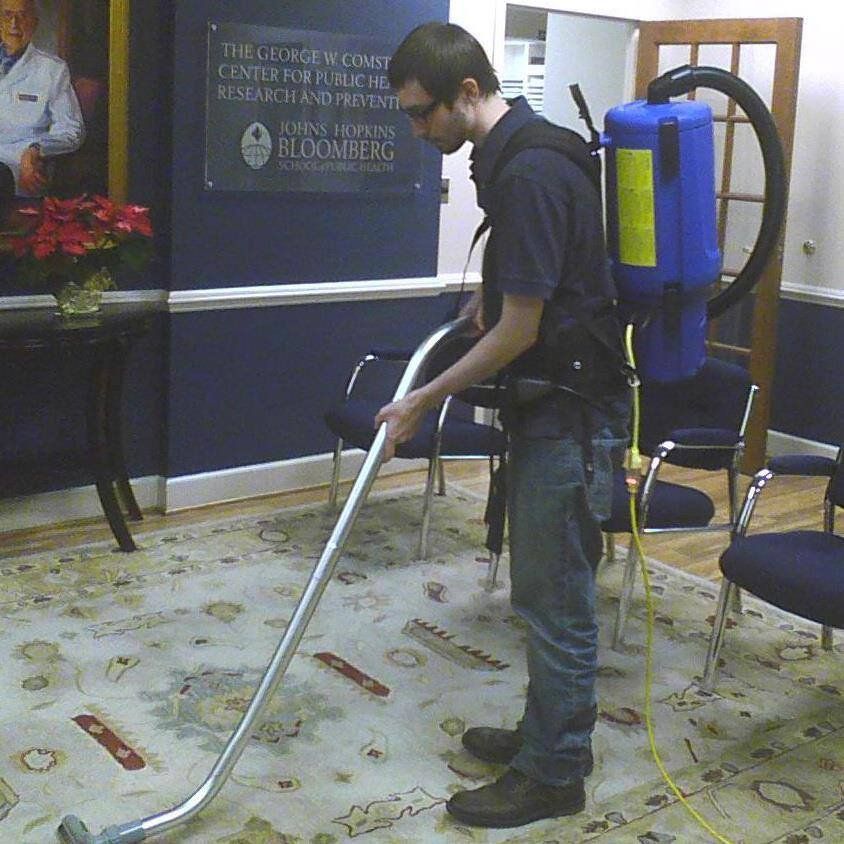
Vacuum, wipe chairs, empty waste |
Spot-clean upholstery, glass |
Deep carpet clean, baseboards |
| Restrooms |
Disinfect fixtures, restock, mop |
Grout scrub, drain care |
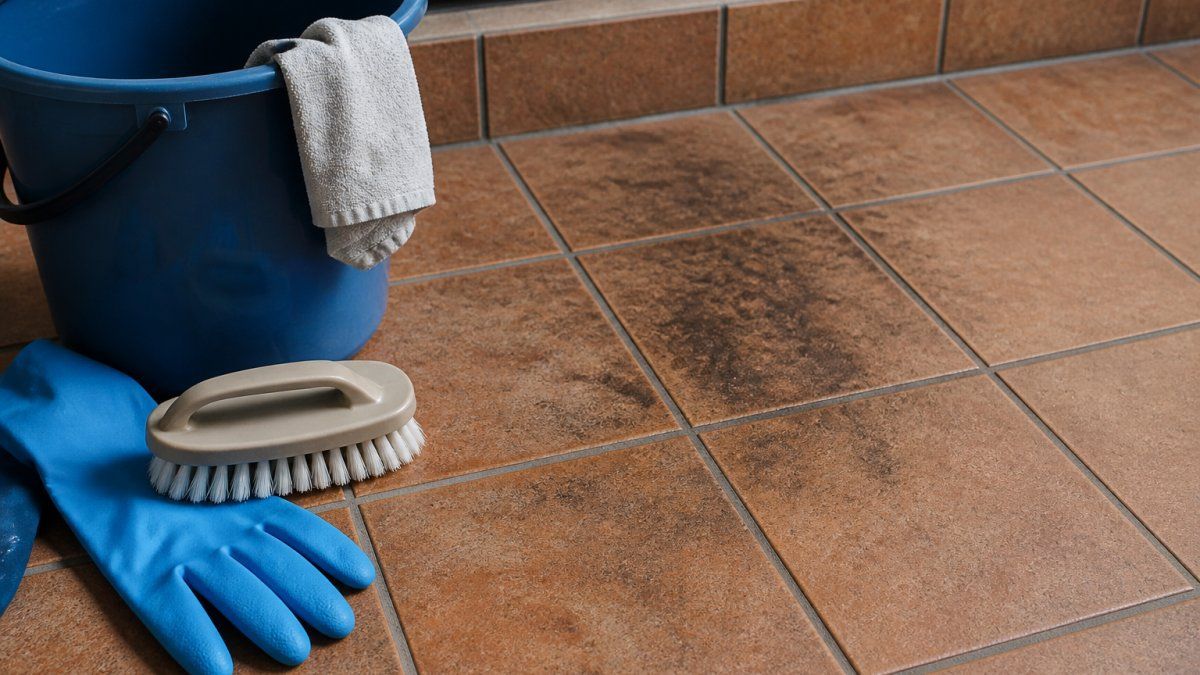
Tile and grout deep clean |
| Break room |
Wipe counters, tables, handles |
Appliance exteriors, floor scrub |
Cabinet fronts, vent dusting |
| Front office |
Dust desks, empty bins, vacuum |
Wipe shared equipment exteriors |
Carpet extraction |
| Hallways and entry |
Dust mop, spot mop, glass doors |
Full mop, entry mat care |
Burnish or scrub-and-recoat |
Watch out: a checklist without frequencies turns into guesswork, and the restrooms are usually the first place it shows.
Who Owns Each Line on the Checklist
A checklist only works when every line has an owner. The matrix above is entirely janitorial work, but the moment a task touches a patient-care surface, it moves to clinical staff. Use this rule of thumb:
- Janitorial-owned: waiting-room furniture, reception desks, restroom fixtures, break-room counters, entry glass, hallway floors, wastebaskets in non-clinical zones, and all commercial floor care.
- Clinical-owned: operatory chairs, delivery units, bracket trays, light handles, instrument processing, and any surface inside the clinical workflow.
- Shared, with a written handoff: the operatory floor (clinical staff contain spills; janitorial cleans the floor on its normal schedule) and the instrument-processing room (treat as clinical unless the practice's written protocol says otherwise).
Putting this in writing stops a well-meaning janitorial crew from wiping a clinical surface with the wrong product, and stops clinical staff from absorbing building-cleaning tasks that pull them away from patients.
Contact Time and Label Compliance on the Non-Clinical Side
Contact time is the number of minutes a disinfectant must stay wet on a surface to work as labeled. On the clinical side, staff follow the manufacturer's instructions for the specific EPA-registered product in use. On the janitorial side, the same discipline applies to restrooms, break rooms, and other non-clinical high-touch surfaces: read the label, match the product to the surface, and let it dwell for the stated time before wiping.
Two practical rules keep this from becoming guesswork:
- Match the product to the finish. A disinfectant that is fine on a restroom fixture can dull or streak an LVT floor or a finished VCT surface. Floor care uses floor-care chemistry, not restroom chemistry.
- Do not mix products. Combining a general cleaner with a disinfectant can reduce the disinfectant's effectiveness or create a hazard. Use one product per task, as labeled.
Verifying the Checklist Actually Happened
A checklist is only as good as the check behind it. Three measures turn a list into a program:
- Completed task logs. A signed or timestamped log per visit, per area, so you can see what was done and when.
- Scheduled inspections. A walkthrough by a supervisor, not the crew that did the work, on a set cadence, scored against the same checklist.
- Periodic ATP swabs on non-clinical high-touch surfaces. ATP testing gives a quick read on whether cleaning actually removed soil from surfaces like reception counters and break-room tables. It is a verification tool, not a substitute for the practice's clinical infection-control protocols, and it does not replace any required clinical testing.
Watch out: an audit that only looks at appearance will pass a dirty surface every time. A surface can look clean and still carry soil that ATP testing would catch.
Building the Schedule Around Patient Hours
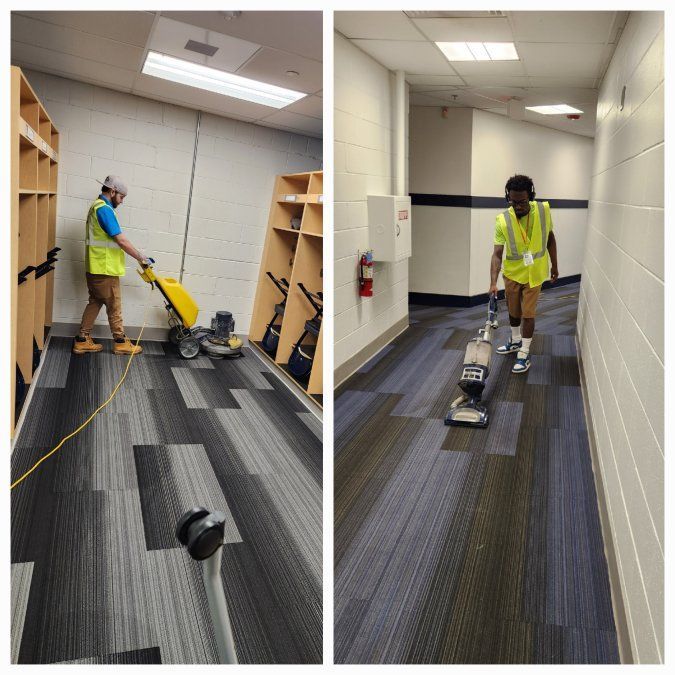
The last piece is timing. Floor care, stripping, waxing, scrub-and-recoat, burnishing, and encapsulation carpet work, needs to be planned around patient hours, not squeezed into a nightly visit.
For practical routines you can hand to a crew, see our floor care tips for medical offices, or review our professional floor care programs if you would rather hand the work off.
Dental Office Floor Maintenance That Keeps Your Practice Looking Professional
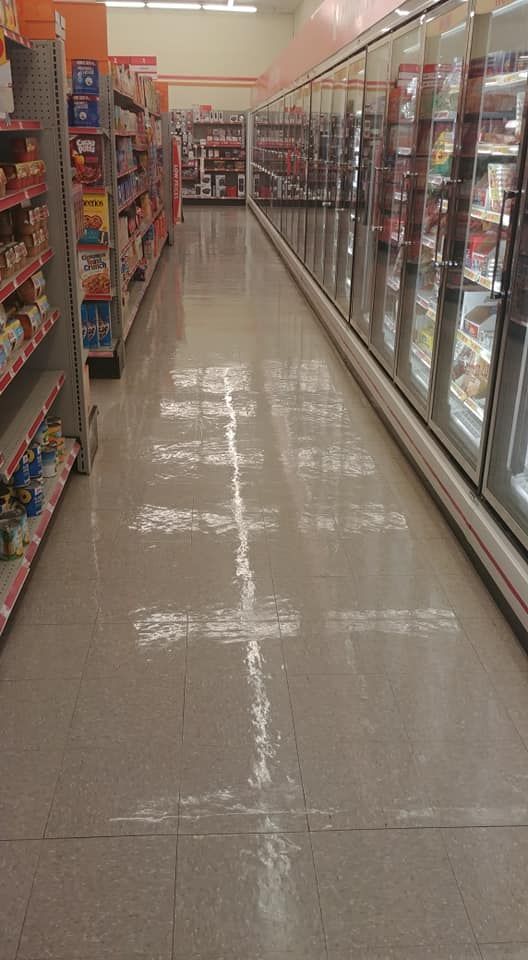
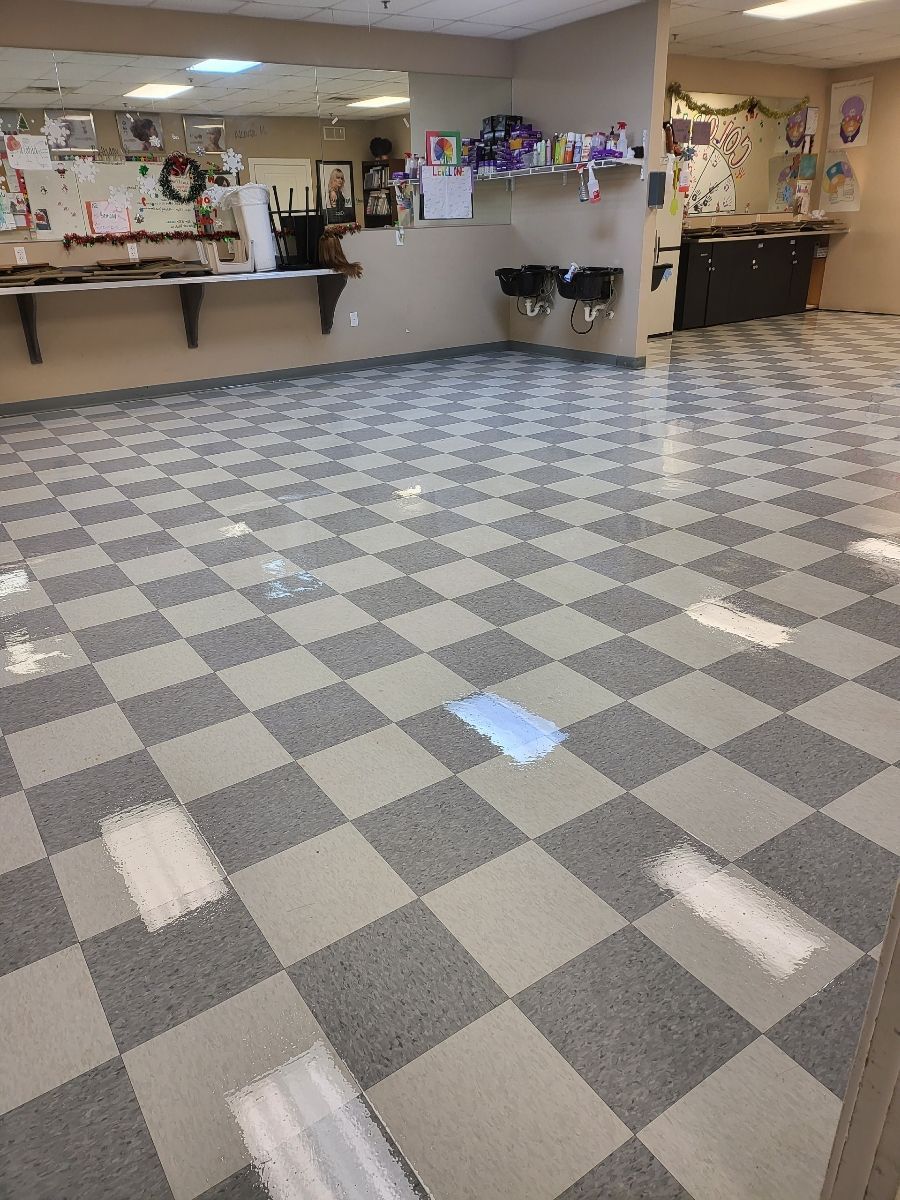
Dental office floor maintenance is where a practice's first impression is won or lost, and it is entirely a janitorial responsibility. Patients notice dull VCT in the hallway before anything else.
The floor mix in most practices is predictable: VCT in corridors and back-of-house, LVT or LVP in reception, carpet in the waiting area, and tile and grout in restrooms.
What Commercial Cleaning for Dental Offices Should Include
Commercial cleaning for dental offices should be scoped in writing, with non-clinical areas named room by room and clinical areas explicitly excluded.
A solid program includes recurring nightly, weekly, or monthly janitorial service; restroom and break-room sanitation; waiting-room and reception care; entry and glass cleaning; waste handling in non-clinical zones; and scheduled floor care. You can review the business cleaning programs a practice can sign up for.
Verifying the Work: Contact Times, Label Compliance, and Audits
Verification separates a cleaning program from a promise. Two things make it work: reading the label and checking the result.
On the janitorial side, we verify with scheduled inspections and a written task log to confirm that cleaning actually removed soil.
Watch out: an audit that only looks at appearance will pass a dirty surface every time.
Request a Walkthrough and Cleaning Estimate for Your Practice
The challenge is simple. Your clinical team should be doing clinical work, and your building should be clean without you chasing it. We built A Smarter Clean around that split: recurring janitorial programs, background-checked staff, OSHA-safe products, and specialized floor restoration, all scoped to the non-clinical areas of your practice.
Get started with A Smarter Clean and a walkthrough of your space. Contact our cleaning company to request a commercial cleaning quote for your practice.
Frequently Asked Questions
What is the difference between janitorial cleaning and clinical disinfection in a dental practice?
Routine janitorial cleaning removes visible soil, dust, and debris from non-clinical areas such as waiting rooms, restrooms, hallways, and offices. Clinical disinfection targets the operatory and patient-care surfaces and is performed by trained dental staff following the practice's infection-control procedures. Cleaning should precede disinfection because organic matter can interfere with how well a disinfectant works. The two tasks are separate, and a general janitorial service should not be treated as a substitute for clinical disinfection.
Who is responsible for disinfecting dental operatories between patients?
Dental staff handle this, not the janitorial crew. Cleaning, disinfection, and sterilization of dental equipment should be assigned to dental health care personnel with training in those procedures. Between patients, trained team members disinfect the dental chair, high-touch surfaces, and reusable items according to the product label and the practice's written protocol. Your commercial cleaner should stay out of the operatory during treatment hours and focus on non-clinical spaces, which keeps responsibility boundaries clear.
Which areas of a dental office are typically handled by routine janitorial cleaning?
Non-clinical areas are the janitorial scope: waiting rooms, reception and front-office desks, hallways, break rooms, restrooms, entrances, and common areas. Floor care also falls here, including VCT stripping and waxing, LVT/LVP maintenance, low-moisture encapsulation carpet cleaning, tile and grout cleaning, scrub-and-recoat, and burnishing. Operatories, instrument processing rooms, and any surface tied to patient care stay with clinical staff, so ask your provider to put that boundary in writing before the first visit.
How should a dental practice coordinate janitorial services with its infection-control procedures?
Start with a written scope that lists which rooms the janitorial team cleans and which are off-limits, then share your infection-control procedures so both sides work from the same map. Schedule cleaning around patient hours, require staff training records, and agree on how tasks are verified, such as a signed checklist or periodic walkthrough. Assigning these duties to trained personnel is important, so confirm who on your team owns oversight. A short monthly review catches drift before it becomes a problem.