



A red metal shed with a white door and window, set against a backdrop of green pine trees and a clear blue sky.

How to Evaluate Commercial Cleaning Service Providers

Editorial Team • October 21, 2026

Table of Contents

Last Updated: October 21, 2026

Start With a Commercial Cleaning Proposal Checklist

Knowing how to evaluate commercial cleaning service providers starts with one document: the proposal. A proposal is the written offer a cleaning company submits before you sign. It should tell you exactly what gets cleaned, how often, and who is accountable.

At A Smarter Clean, we've reviewed enough bids to know that most proposals are too vague to compare. A short checklist fixes that:

  • Building address and square footage listed
  • Task list by room or area
  • Frequency for each task
  • Supplies and equipment included
  • Floor care listed separately
  • Start date and contract term
  • Insurance and contact details attached

If a proposal skips any of these, ask for it in writing. A company that won't put details on paper now won't deliver them later.

Questions to Ask a Commercial Cleaning Company Before You Sign

Ask direct questions, and listen for direct answers. The U.S. Small Business Administration guide to choosing a vendor recommends checking references and getting everything in writing before signing. That advice applies here too.

Here are the questions we hear most from facility managers, and what a good answer sounds like:

  • Who cleans our building? You want named supervisors and consistent crews, not a rotating cast.
  • How do you handle callouts? A clear backup plan beats a promise.
  • What's your quality check process? Look for scheduled inspections, not "we just know."
  • Can you handle floor care ? Ask about VCT stripping and waxing, scrub-and-recoat, and burnishing.
  • What does the contract cover? Extra charges should be spelled out, not sprung on you.

Pro Tip
Ask for the name of the account supervisor who will actually manage your building. If the salesperson can't answer that, the handoff after signing is usually where service slips.

Demand a Clear Janitorial Services Scope of Work

A janitorial services scope of work is the written list of tasks, frequencies, and standards that defines the job. It is the single most important part of any cleaning contract. Without it, "clean" means whatever the crew decides that day.

Facility manager and supervisor reviewing a scope of work document in a medical office to evaluate cleaning services.

A strong scope of work covers:

  • Daily tasks: trash, restrooms, spot mopping, vacuuming high-traffic areas
  • Weekly and monthly tasks: dusting high surfaces, deep restroom detail, floor buffing
  • Periodic tasks: carpet cleaning, tile and grout cleaning, floor stripping and waxing
  • Standards: what "done" looks like for each area
  • Exclusions: what is not included, so there are no surprises

Medical and dental offices need extra attention to restroom and touch-point cleaning. Spell that out. Schools and churches need gym and hallway floors on a set schedule. Banks need lobby glass and entry areas on a reliable rhythm. The scope should match your building, not a generic template.

How to Judge Reliability and Communication

Reliability shows up in small habits: crews arriving on schedule, the same supervisor answering the phone, and problems fixed without three follow-up emails. You can't test that in a sales meeting, so test it before you sign.

Try these steps:

  1. Call the company's main line during business hours and time the response.
  2. Ask how they report issues and who receives complaints.
  3. Request a sample inspection report.
  4. Ask what happens when a crew member calls out sick.

A dependable provider answers these without hesitation. A weak one promises "great communication" and gives you no process behind it.

Watch Out
Don't sign a long contract with a company that won't name a supervisor or share an inspection process. You'll be locked in with no clear path to fix problems.

Build a Commercial Floor Maintenance Program Into the Contract

Floors are where cheap cleaning contracts fall apart. A commercial floor maintenance program is a scheduled plan for protecting hard floors and carpet over time, not just reacting when they look bad. Build it into the contract from day one.

Here is what a solid program covers:

Floor Type

Service

Typical Frequency

VCT

Strip and wax

1-2 times per year

VCT

Scrub-and-recoat

Every 3-6 months

VCT

Burnishing

Weekly or monthly

LVT/LVP

Cleaning and light finish care

Per manufacturer guidance

Carpet

Low-moisture encapsulation cleaning

Quarterly or as needed

Tile and grout

Deep cleaning

1-2 times per year

Ask the provider to explain each service in plain terms. Stripping removes old finish and wax; recoating adds a fresh layer; burnishing polishes the surface between recoats. LVT/LVP needs different care than VCT, and a provider who treats them the same will dull your floors.

At A Smarter Clean, our recurring floor care covers VCT stripping and waxing, scrub-and-recoat, burnishing, LVT/LVP maintenance, low-moisture carpet cleaning, and tile and grout cleaning. We build these into a scheduled program so floors stay protected instead of being rescued after damage sets in.

Verify Insurance, References, and Quality Control

Insurance and references are your safety net. Ask for a certificate of insurance before work starts, and confirm it names general liability coverage. Then call two or three current clients with buildings like yours.

The Occupational Safety and Health Administration publishes guidance on chemical safety and hazard communication in the workplace. Ask which products the company uses and whether safety data sheets are available for your files. A provider that uses OSHA-safe products should be able to show you the documentation without delay.

Quality control is the third leg. Ask:

  • How often are inspections done, and by whom?
  • Do you share written reports?
  • How are complaints tracked and closed out?
  • Can we walk the building together on a set schedule?

Key Takeaway
Insurance protects you from liability, references confirm the company delivers, and quality control keeps service from drifting. All three belong in your evaluation, not just the price.

Conclusion: Choose Commercial Cleaning Providers Who Prove Their Process

The hardest part of hiring a cleaning company is trusting that the service you're promised is the service you'll get. The fix is simple: make providers prove their process before you sign. A detailed proposal, a clear janitorial services scope of work, a real floor maintenance plan, and verifiable insurance and references separate serious providers from sales pitches.

That's how we built A Smarter Clean. We offer flexible nightly, weekly, or monthly janitorial programs, low-moisture carpet cleaning, and scheduled floor care across Delaware and Maryland's Eastern Shore. We put our scope of work in writing and stand behind it with responsive communication and dependable crews.

Request a walkthrough and a customized cleaning proposal from A Smarter Clean, and compare our process side by side with anyone else you're considering.

Frequently Asked Questions

What should a commercial cleaning proposal include?

A complete proposal should list the tasks performed and how often, the areas covered, the products used, staffing and supervision, start dates, and how changes are handled. It should also state insurance coverage, complaint procedures, and the terms for adding periodic work such as VCT stripping and waxing or low-moisture encapsulation carpet cleaning. If a proposal is vague about frequency or square footage, ask for a revised version before comparing it with others.

How can I check the quality of a commercial cleaning provider?

Ask for references from facilities similar to yours, then visit one during or right after a shift. Look at floors, restrooms, and high-touch areas, and ask the contact how quickly the provider responds to complaints. A written quality-control process, such as scheduled inspections with a report you receive, gives you something to hold the provider to. Without inspections, quality tends to drift once the first month passes.

What insurance should a commercial cleaning company have?

Ask for a certificate of general liability insurance and workers' compensation coverage, and confirm the certificate is current and names your facility type. Verify the limits directly with the insurer if the document looks unclear, and keep a copy on file. This matters most in medical and dental offices, where a slip or an equipment mishap can become a liability question for your own operation.

Can one provider handle both janitorial cleaning and floor care?

Yes, and it usually simplifies scheduling. A provider that handles recurring janitorial work and periodic floor maintenance can plan VCT stripping and waxing, scrub-and-recoat, burnishing, LVT/LVP care, and tile and grout cleaning around your hours instead of handing you off to a subcontractor. Ask how they sequence floor work, how many nights it takes, and who supervises it before you sign.

By Editorial Team • October 21, 2026
Safe carpet cleaning solutions for allergy sufferers in commercial facilities. Learn vacuuming, spot treatment, and low-moisture methods that reduce dust.
By Editorial Team • October 19, 2026
Facility management outsourcing trends 2026: bundled janitorial and floor care, customized schedules, quality control, and vendor partnerships
By Editorial Team • October 16, 2026
Discover 7 practical ways to optimize facility operations for efficiency through better cleaning schedules, floor maintenance, and vendor coordination.
By Editorial Team • October 15, 2026
Learn how to create a facility management outsourcing checklist covering scope, frequency, vendor evaluation, and floor care for your building.
By Editorial Team • October 14, 2026
Discover 5 best practices for vendor management in facilities, from scopes of work to performance reviews. Build a cleaner, more accountable building.
By Editorial Team • October 13, 2026
Keep high-traffic office floors looking sharp. Learn VCT and LVT care schedules, routine cleaning steps, and when to strip and wax.
By Editorial Team • October 12, 2026
A 2026 review of specialized floor restoration and maintenance for engineering firms, covering VCT, LVT, schedules, and contractor selection.
By Editorial Team • October 11, 2026
Learn how responsive commercial cleaning, proper procedures, and reliable janitorial maintenance create cleaner, safer environments for your facility.
By Editorial Team • October 10, 2026
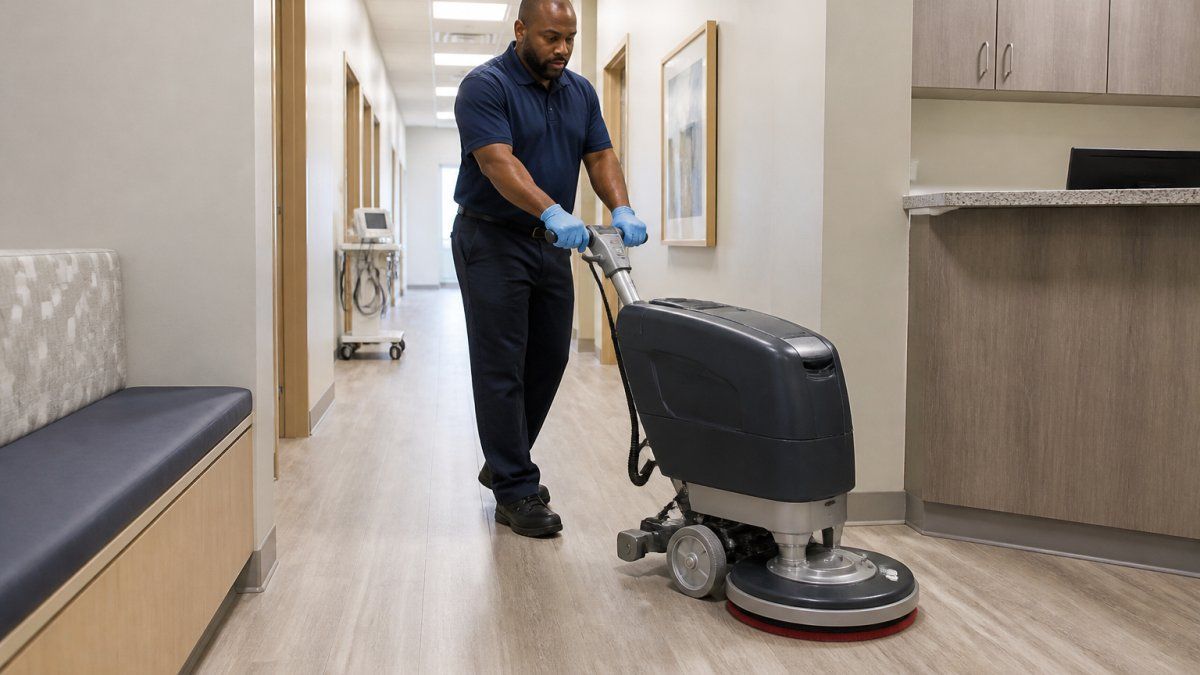
Clean commercial LVT flooring: Learn proper commercial LVT floor cleaning: routine maintenance, neutral cleaners, machine scrubbing, and high-traffic care.

By Editorial Team • October 8, 2026
Build customizable cleaning schedules that keep trained staff on task. Covers templates, checklists, frequency guides, and floor care planning.
Show More