


Commercial VCT and LVT Floor Care: Maintenance and Restoration Guide
Table of Contents
- Why Proper VCT and LVT Maintenance Matters in Commercial Facilities
- VCT and LVT Are Not the Same: A Maintenance Comparison
- Commercial VCT Floor Stripping and Waxing: What the Process Involves
- VCT Scrub and Recoat: Extending the Cycle Between Full Strips
- Commercial LVT Floor Cleaning and Maintenance Done Correctly
- Building a Commercial Floor Maintenance Schedule Around Facility Use
- Table of Contents
- Why Proper VCT and LVT Maintenance Matters in Commercial Facilities
- VCT and LVT Are Not the Same: A Maintenance Comparison
- Commercial VCT Floor Stripping and Waxing: What the Process Involves
- VCT Scrub and Recoat: Extending the Cycle Between Full Strips
- Commercial LVT Floor Cleaning and Maintenance Done Correctly
- Building a Commercial Floor Maintenance Schedule Around Facility Use
- Restoration Options for Heavily Worn Commercial Flooring
- Choosing a Floor Care Provider and Requesting a Walkthrough
- Frequently Asked Questions
- Restoration Options for Heavily Worn Commercial Flooring
- Choosing a Floor Care Provider and Requesting a Walkthrough
- Frequently Asked Questions
Last Updated: October 12, 2026
Why Proper VCT and LVT Maintenance Matters in Commercial Facilities
Floor restoration brings a worn commercial floor back to a clean, professional, safe condition through deep cleaning, finish removal, recoating, or resurfacing rather than full replacement. For engineering firms, labs, and technical offices, rolling equipment, chemical exposure, and constant foot traffic wear floors in ways standard janitorial mopping won't touch.
At A Smarter Clean, we work with facility and operations managers across Sussex and Kent Counties in Delaware and Maryland's Eastern Shore. This guide covers how VCT and LVT/LVP floors differ, what professional restoration and maintenance cycles look like, and how to tell whether your floor needs a strip, a scrub-and-recoat, or something else.
Treating every vinyl floor the same is the fastest way to void a manufacturer's warranty and wreck a floor that was perfectly fine.
VCT and LVT Are Not the Same: A Maintenance Comparison
VCT (vinyl composition tile) and LVT/LVP (luxury vinyl tile/plank) are two different flooring systems with two different maintenance rules. VCT is a porous tile that relies on a topical finish for protection and shine, while LVT/LVP typically has a factory-applied wear layer that should not be stripped with traditional finish removers. Applying VCT methods to LVT/LVP is one of the most common and costly mistakes we see.
| Factor |
VCT |
LVT/LVP |
|---|---|---|
| Protective layer |
Topical wax or finish applied on site |
Factory wear layer |
| Stripping |
Standard part of the cycle |
Usually not recommended |
| Routine care |
Machine scrub, burnish, recoat |
pH-neutral cleaner, routine machine scrubbing |
| Finish system |
Reapplied as it wears |
Maintained per manufacturer guidance |
How VCT Responds to Stripping and Waxing
VCT is built to be stripped and rewaxed. The finish sits on top of the tile, so when it dulls, scratches, or yellows, a professional can remove the old finish and apply new coats. What matters is the right schedule, not a fixed calendar.
Why Many LVT/LVP Floors Should Not Be Stripped
Many LVT/LVP floors are not designed for traditional stripping and waxing. The wear layer is factory-applied, and aggressive strippers can dull, cloud, or permanently damage it. These floors should be maintained according to the manufacturer's recommendations and the specific finish system already in place, usually pH-neutral cleaning and routine machine scrubbing instead of stripping.
Commercial VCT Floor Stripping and Waxing: What the Process Involves
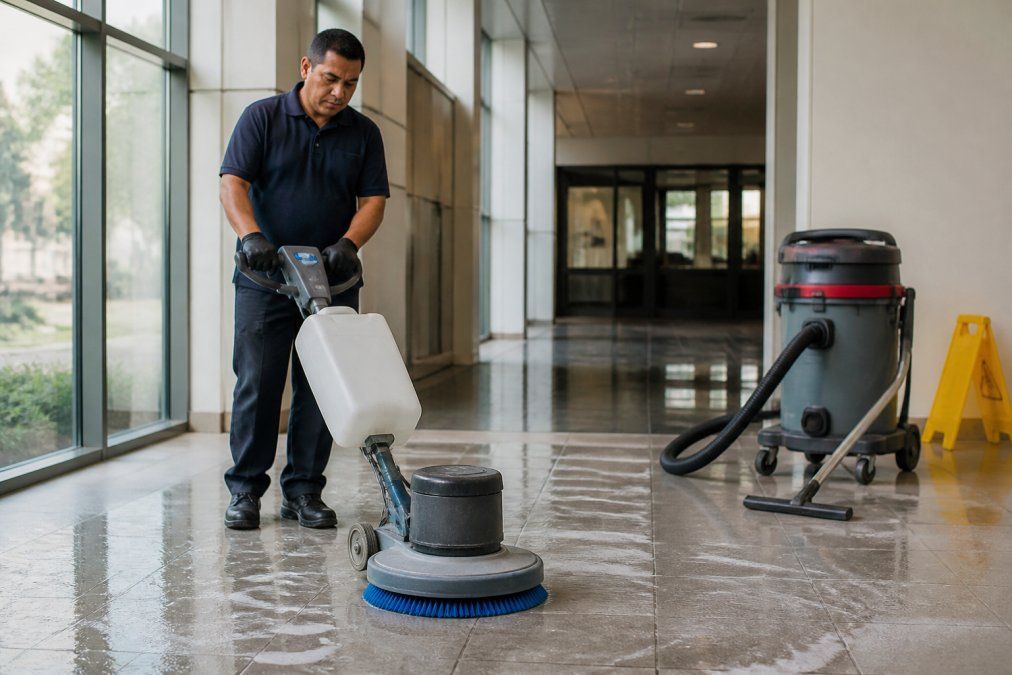
Commercial VCT floor stripping and waxing is a multi-step process: protect the area, apply stripper, agitate with a floor machine, extract the slurry, neutralize and rinse, let the floor dry fully, then apply multiple thin coats of finish.
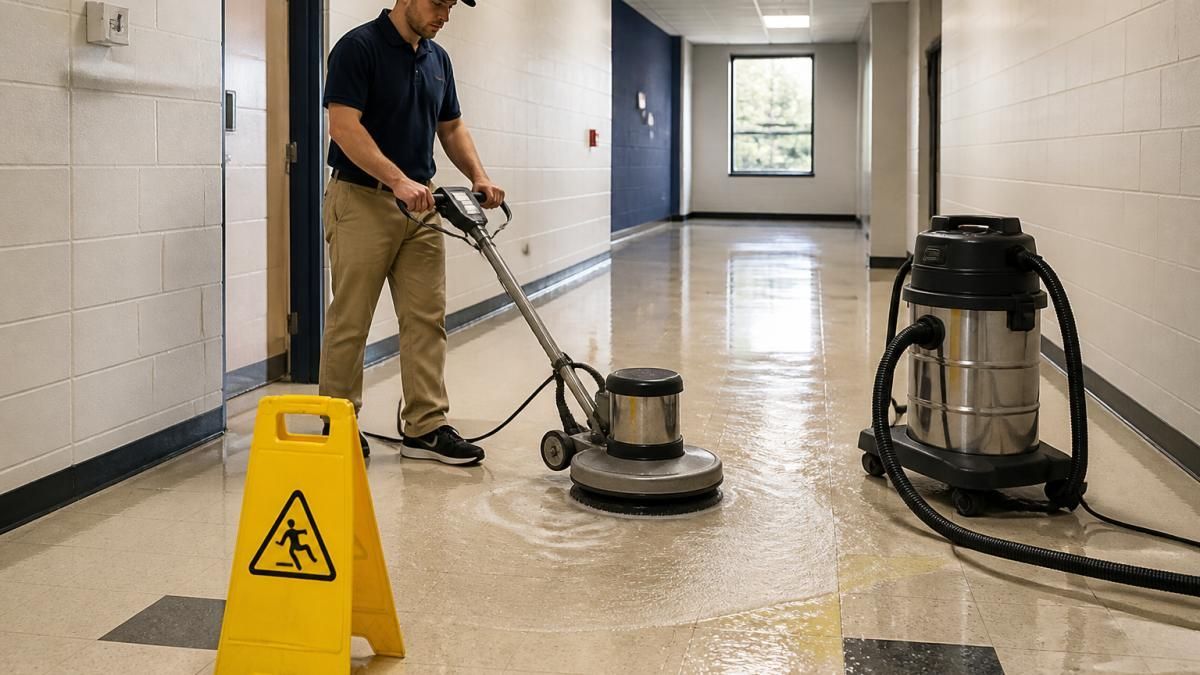
A proper strip takes a floor out of service for a window of time, so most facilities schedule it overnight or on a weekend. Rushing the dry time traps moisture under the finish and causes peeling within weeks.
VCT Scrub and Recoat: Extending the Cycle Between Full Strips
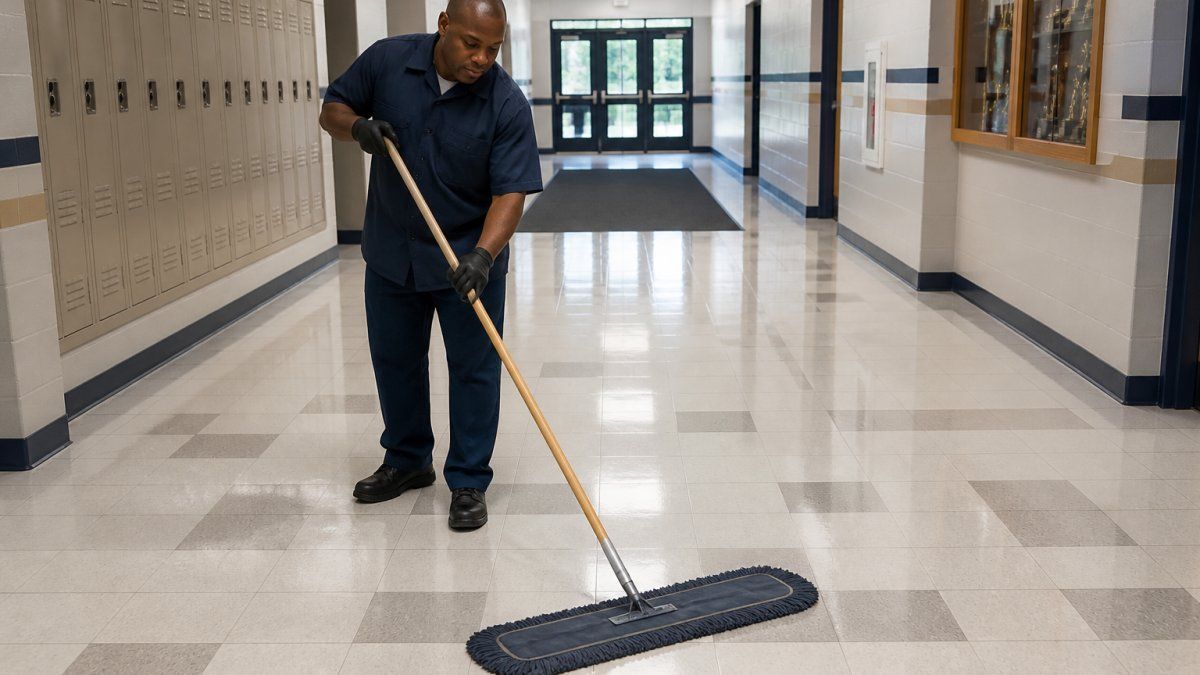
VCT scrub and recoat cleans the existing finish and adds a fresh layer on top, pushing back the next full strip. It's less disruptive than a strip and is the workhorse of many floor care programs.
Recoat only works if the finish underneath is sound. With heavy buildup, deep scratches, or discoloration, recoating seals the problem in. A good provider will tell you which one you actually need.
Commercial LVT Floor Cleaning and Maintenance Done Correctly
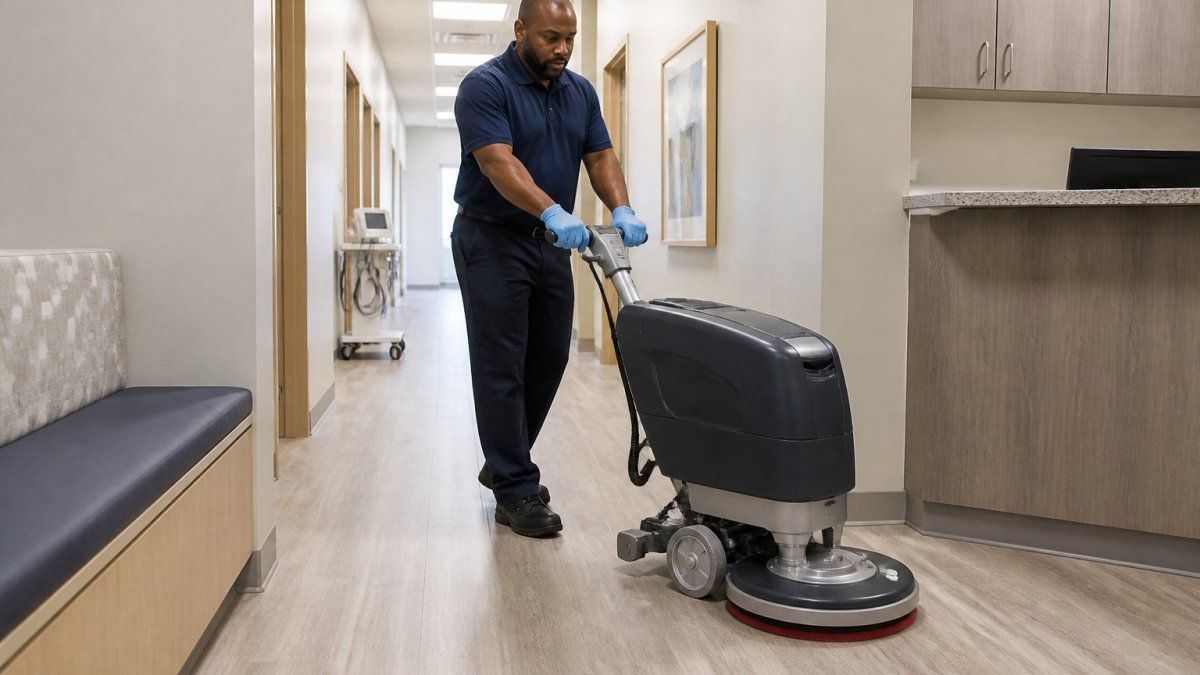
Commercial LVT floor cleaning and maintenance starts with the right chemistry: pH-neutral cleaners matched to the manufacturer's guidance, no abrasive pads, and routine machine scrubbing to lift soil without attacking the wear layer.
LVT/LVP still needs a scheduled program, not just spot cleaning. High-traffic entries, break rooms, and corridors collect grit that acts like sandpaper under foot traffic; routine machine scrubbing removes it before it dulls the surface.
Building a Commercial Floor Maintenance Schedule Around Facility Use
A commercial floor maintenance schedule is built from three inputs: traffic level, current floor condition, and how the space is used. There's no universal calendar. A hospital corridor and a private office lobby can have the same square footage and need completely different frequencies.
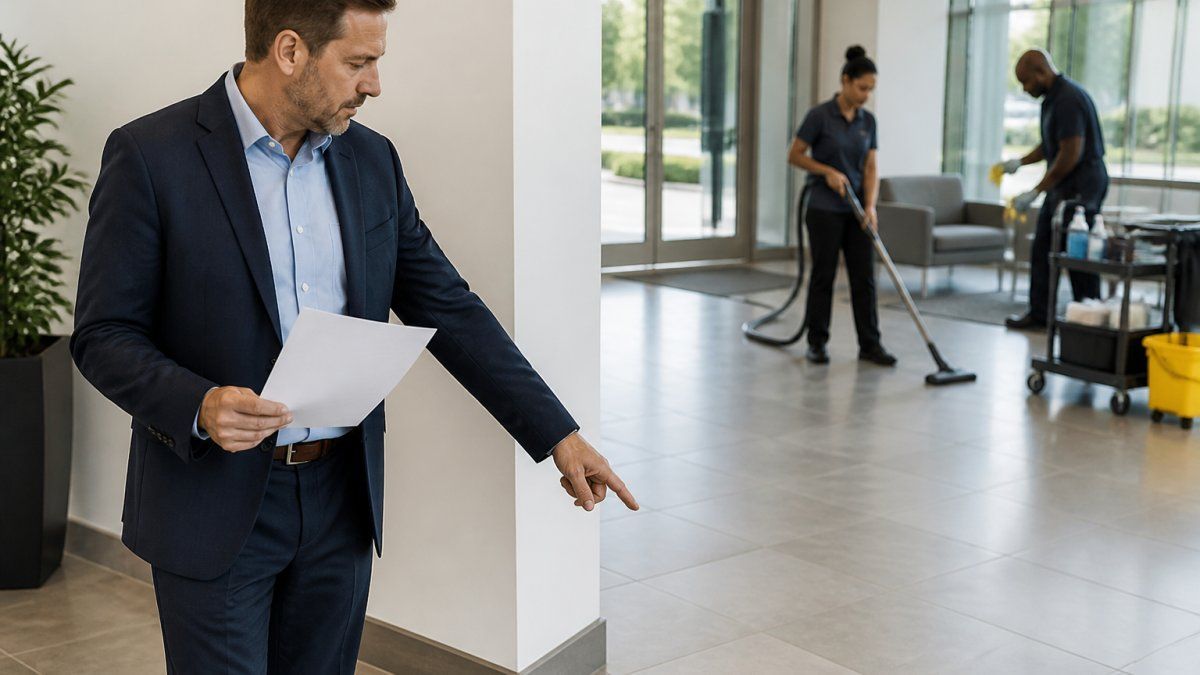
A schedule without a routine walk-through is just a guess with dates attached. Pair each zone with a service frequency and an inspection frequency; the inspection tells you whether the frequency is still right.
Zone the Facility by Use, Not Just by Traffic
Engineering facilities rarely divide cleanly into "high traffic" and "low traffic", they divide by what happens on the floor.
Walk the facility and mark each area with three notes: what rolls across the floor (carts, pallet jacks, instrument dollies, chairs), what can land on it (coolant, solvents, solder flux, coffee, road salt), and who sees it (clients, auditors, staff only).
| Zone type |
Typical traffic |
Common exposure |
Service focus |
Inspection cadence |
|---|---|---|---|---|
| Entrances and lobbies |
High |
Tracked grit, moisture, salt |
Machine scrub, burnish, recoat |
Monthly |
| Main corridors |
High |
Foot traffic, cart wheels |
Machine scrub, burnish |
Monthly |
| Drafting and office areas |
Medium |
Chair casters, paper dust |
Routine cleaning, spot recoat |
Quarterly |
| Break rooms and cafeterias |
Medium-high |
Food, drink, grease |
Deep clean, spot recoat |
Monthly |
| Labs and calibration rooms |
Low to medium |
Chemical drips, spills |
pH-neutral cleaning per floor type, immediate spill response |
Monthly |
| Machine shops and fabrication |
Medium-high |
Metal chips, coolant, oil |
Machine scrub, degrease per manufacturer guidance |
Monthly |
| Parts staging and storage |
Medium |
Abrasive grit, pallet traffic |
Routine cleaning, condition check |
Quarterly |
| Server and IT rooms |
Low |
Dust, occasional cable work |
Routine cleaning only |
Quarterly |
Set Inspection Cadence Separately From Service Cadence
Service frequency is how often the floor gets worked on. Inspection frequency is how often someone qualified looks at it and decides whether the service frequency still fits.
A workable pattern: monthly walk-throughs of high-traffic and exposure zones, quarterly walk-throughs of everything else, and an immediate look after any spill, leak, or construction activity.
Keep the notes in one place.
Let Condition, Not the Calendar, Trigger the Big Jobs
Condition drives the rest. Dull spots and light scratches may only need a scrub and recoat; heavy buildup or discoloration likely needs a full strip.
Three triggers are worth writing into the plan:
- Appearance trigger: gloss loss that a burnish no longer corrects across more than a small area.
- Buildup trigger: visible finish ridges at edges, under casework, or along walls where the machine can't reach.
- Damage trigger: deep scratches, gouges, or wear-layer clouding that cleaning won't lift.
The first two usually point to a scrub and recoat on VCT. The third points to a strip on VCT, or to manufacturer guidance and possible targeted plank replacement on LVT/LVP. None of these should be decided from a hallway glance.
Plan Around Facility Operations, Not Against Them
Stripping and recoating take floor areas out of service for a window of time, so the schedule has to account for how the space is used. Labs with sensitive instruments, areas with active projects, and client-facing spaces usually need work outside business hours or during planned shutdowns; back-of-house corridors and storage areas are often more flexible.
A few practical points that come up in engineering facilities:
- Access and egress: confirm that fire exits, ADA routes, and equipment paths stay clear while finish cures.
- Sensitive equipment: cover or relocate instruments, servers, and calibration gear before any wet work begins.
- Chemical compatibility: tell the provider what chemicals are used in each area so cleaning products and finish systems are matched to the environment.
Restoration Options for Heavily Worn Commercial Flooring
Heavily worn commercial flooring usually has more than one path forward, depending on the floor type and how far the damage goes. For VCT, restoration often means a full strip and rebuild of the finish system.
The decision framework is straightforward:
- Light wear, dull finish: scrub and recoat
- Moderate buildup, uneven appearance: full strip and rewax (VCT only)
- Deep scratches, discoloration, or damage: assess for targeted repair or replacement
What that framework doesn't tell you is how the answer changes inside an engineering facility. A lab floor, a shop floor, and a client-facing lobby can all be the same product and still need different restoration approaches because of what lands on them and who walks on them.
Match the Restoration Approach to the Space
| Space type |
Common floor type |
Restoration approach |
Key consideration |
|---|---|---|---|
| Client-facing lobby |
VCT or LVT/LVP |
Scrub and recoat, or strip and rebuild on VCT |
Appearance is the priority; schedule around business hours |
| Drafting and office areas |
VCT or LVT/LVP |
Scrub and recoat; spot repair |
Chair caster wear concentrates in traffic lanes |
| Labs and calibration rooms |
Often LVT/LVP or sheet vinyl |
Deep clean per manufacturer guidance |
Chemical compatibility of cleaner and finish |
| Machine shops and fabrication |
Often sealed concrete or VCT |
Degrease, scrub, recoat or reseal |
Metal chips and coolant require pre-clean before any finish work |
| Parts staging and storage |
VCT, LVT/LVP, or concrete |
Routine clean, targeted repair |
Abrasive grit accelerates wear at entries |
| Server and IT rooms |
LVT/LVP or raised floor |
Routine clean only |
Access panels and cable routing limit wet methods |
What Changes When the Floor Is in a Lab or Shop
Two things change the restoration conversation in technical spaces: what can get on the floor, and what can't be moved out of the way.
On the chemical side, the finish system and cleaner have to be compatible with what the space actually uses.
On the access side, restoration work in a lab or shop usually has to fit around equipment that can't easily move, working in sections, protecting instruments and calibration gear, and keeping fire exits, ADA routes, and equipment paths clear while finish cures.
Repair Thresholds: When Restoration Stops Making Sense
Restoration is not always the right call. At some point the disruption outweighs what you get back, and targeted replacement becomes more sensible. The threshold differs by facility, but a few signals usually point toward replacement:
- Wear-layer breakthrough on LVT/LVP: once the pattern layer is exposed, no cleaning or finish will bring it back.
- Delamination or lifting: planks or tiles that have lost adhesion won't be fixed by a recoat.
- Widespread gouging or substrate damage: if the damage goes below the surface, finish work just hides it temporarily.
In those cases, restore the areas that will respond and replace the areas that won't, rather than applying a uniform treatment across the whole facility.
Plan Restoration Around Operational Continuity
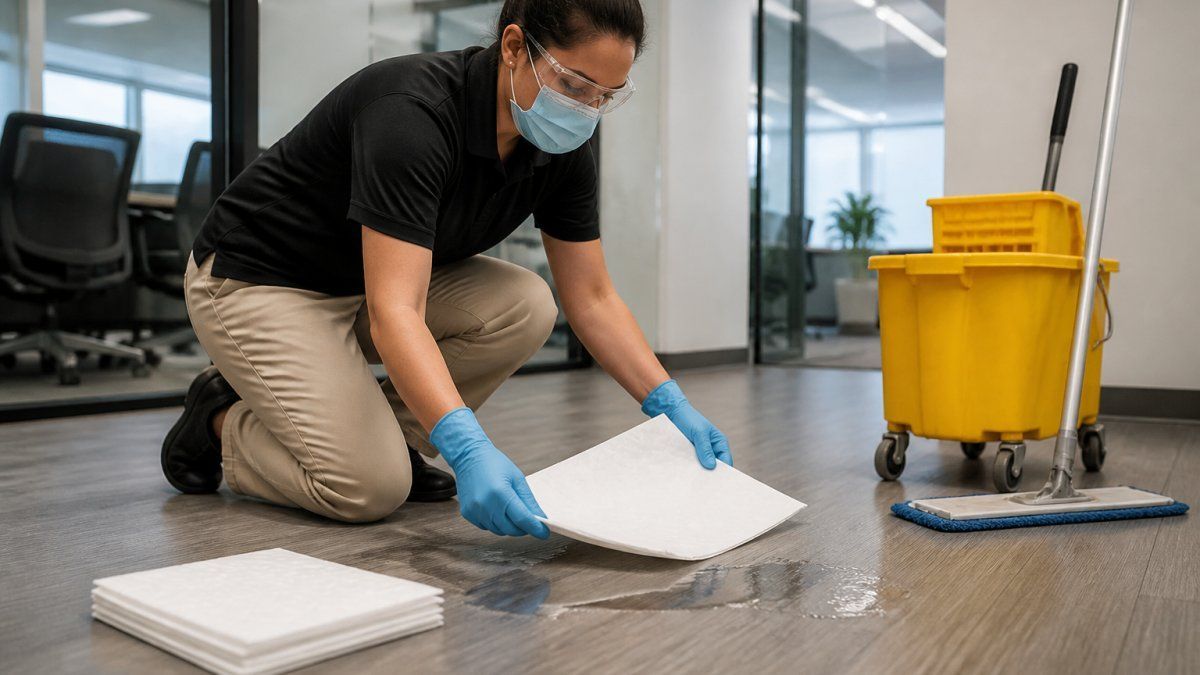
Restoration work takes floor areas out of service, and in an engineering facility that has a real cost. The plan should say, in advance, which areas go offline, for how long, and what happens to the work that normally occurs there.
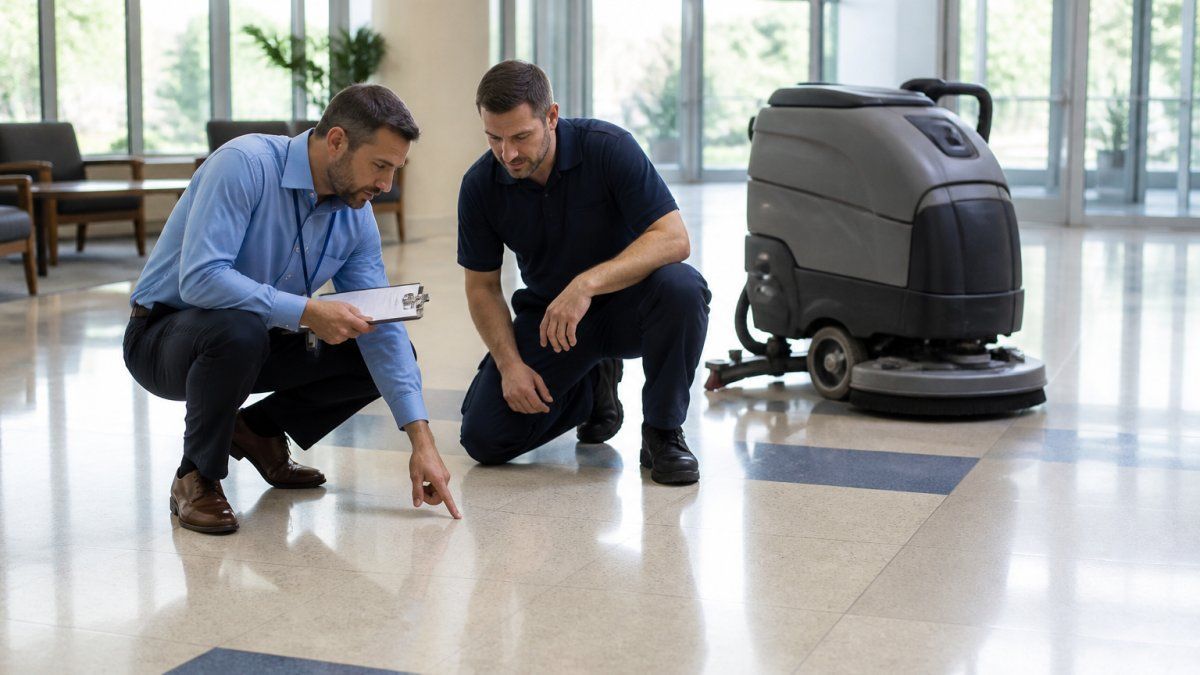
A walkthrough is the only reliable way to know which category your floor falls into. Guessing leads to unnecessary work or a floor that keeps getting worse.
Choosing a Floor Care Provider and Requesting a Walkthrough
Choosing a floor care provider comes down to whether they'll assess your floor honestly and maintain it on a schedule that fits your facility. Ask what products they use, how they handle VCT versus LVT/LVP, and whether they'll put a written maintenance plan in front of you before any work starts.
At A Smarter Clean, we provide specialized floor restoration and maintenance for commercial facilities across Sussex and Kent Counties in Delaware and Maryland's Eastern Shore. Our recurring floor care covers LVT/LVP, VCT stripping and waxing, concrete floor cleaning and sealing, and tile and grout cleaning, with flexible nightly, weekly, or monthly programs built around your facility's needs.
Frequently Asked Questions
How often should commercial VCT floors be stripped and waxed?
Frequency depends on traffic, soil levels, and how well the floor is maintained between strips. High-traffic areas in engineering offices, schools, and medical buildings may need stripping more often than back-office or storage areas. Many facilities alternate full stripping with scrub-and-recoat cycles to extend the time between strips. A floor care provider can assess surface condition and recommend an interval that fits your building's use.
What is the difference between VCT and LVT flooring?
VCT (vinyl composition tile) is a traditional tile floor finished with wax or polymer floor finish, which is maintained through stripping, recoating, and burnishing. LVT (luxury vinyl tile) and LVP (luxury vinyl plank) are different products with a wear layer and a factory finish. Many LVT and LVP floors are not designed for traditional stripping and waxing, so they should be cleaned and maintained according to the manufacturer's recommendations and the specific finish system in place.
Can you strip and wax LVT or LVP floors?
In most cases, no. Many LVT and LVP floors are not designed for traditional stripping and waxing, and using those methods can damage the wear layer or void the manufacturer's warranty. Commercial LVT floor cleaning and maintenance should follow the manufacturer's guidance, which typically involves routine cleaning and, in some cases, a specific approved finish system. A professional floor care provider can confirm what your floor requires before any work begins.
When should a VCT floor be scrubbed and recoated instead of stripped?
Scrub and recoat is usually the right choice when the finish is dull or scuffed but still intact and the tile underneath is in good condition. Full stripping is reserved for cases where finish has built up unevenly, the floor is heavily soiled, or the surface needs a fresh start. Alternating scrub-and-recoat cycles with occasional stripping helps maintain appearance while reducing the wear that repeated stripping can cause.
What affects the maintenance schedule for commercial floors?
Traffic levels, floor condition, facility use, and maintenance frequency all shape the schedule. An engineering office with heavy foot traffic and rolling equipment needs different care than a church, bank, or dental office. A commercial floor maintenance schedule should be built around how each space is used, how quickly soil and wear appear, and whether the floor is VCT or LVT/LVP. Routine cleaning and preventive maintenance between deeper services keep the schedule effective.
Every commercial floor eventually reaches a point where routine cleaning isn't enough, and the facilities that handle it well are the ones with a plan in place before that happens. A Smarter Clean builds that plan around your floor types, traffic patterns, and operating hours, with specialized floor restoration and maintenance, flexible scheduling, and OSHA-safe products. Request a walkthrough and floor-care estimate from A Smarter Clean and get a clear picture of what your floors actually need.