

Commercial Carpet Maintenance Tips for Facility Managers
Table of Contents
- Why Commercial Carpet Maintenance Is a Business Decision
- Building a Commercial Carpet Maintenance Schedule That Works
- Commercial Carpet Stain Removal Techniques for Common Spills
- How a Preventative Carpet Maintenance Program Saves Money
- In-House vs. Outsourced Carpet Care: A Cost-Benefit Look
- Carpet Warranty Compliance: What Facility Managers Often Miss
- Green Cleaning and Indoor Air Quality in Carpet Maintenance
- Frequently Asked Questions
Last Updated: September 16, 2026
Why Commercial Carpet Maintenance Is a Business Decision
Commercial carpet maintenance is the planned practice of protecting carpet investments through scheduled cleaning, soil control, and fiber care. For facility managers, it's a budget line, a liability question, and a tenant satisfaction issue rolled into one. This guide from A Smarter Clean breaks down the schedule, stain, and vendor decisions that actually move the needle.
Carpet is the single largest soft-surface investment in most commercial buildings, and it takes the most abuse. A properly managed carpet maintenance program can extend carpet life by years, deferring replacement costs that run into the tens of thousands of dollars for a mid-size facility.
The problem is that most facilities treat carpet care reactively. Something spills, someone calls a vendor, the stain sets, and the carpet ages faster than it should. The facility managers who get this right treat carpet like any other asset with a lifecycle: inspect it, schedule it, document it.
Below, we'll show you exactly how to build that schedule, handle spills before they set, and decide what to outsource.
Building a Commercial Carpet Maintenance Schedule That Works
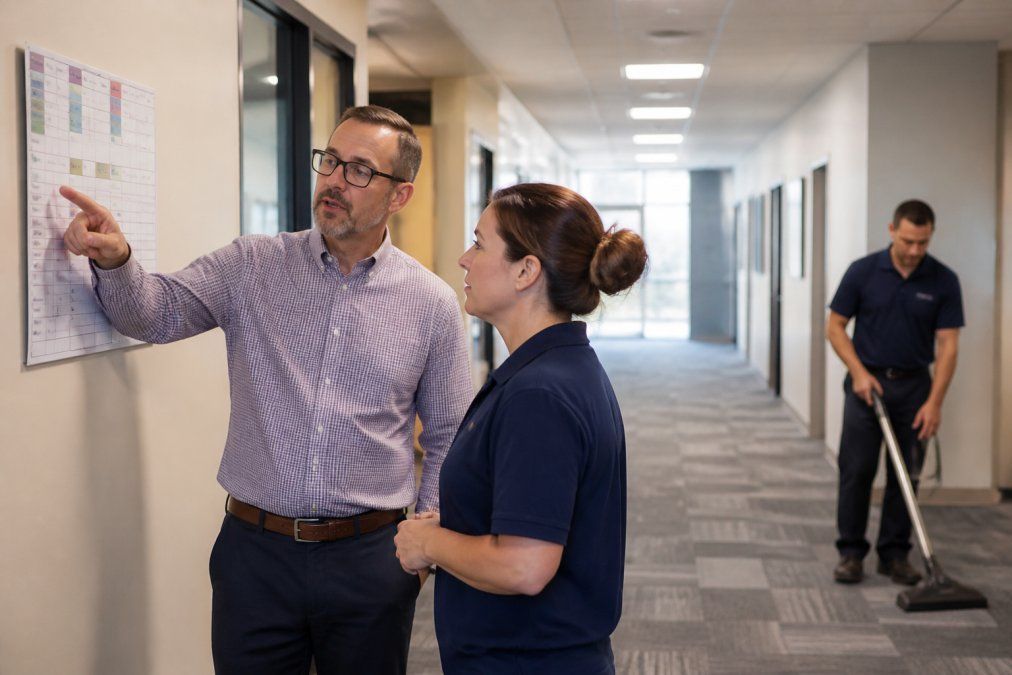
A commercial carpet maintenance schedule is a written plan that assigns cleaning tasks to daily, weekly, quarterly, and annual intervals based on traffic volume and soil load. The schedule matters more than the equipment.
Daily, Weekly, and Quarterly Tasks
Daily tasks prevent soil from working into the carpet backing. Weekly tasks address traffic lanes. Quarterly tasks restore the pile.
- Daily: vacuum all entryways and high-traffic paths
- Daily: spot-treat spills within the same shift
- Weekly: vacuum under desks and in low-traffic zones
- Monthly: inspect traffic lanes for pile crushing
- Quarterly: deep clean high-traffic areas
- Annually: full-facility deep clean and warranty review
High-Traffic Area Management
High-traffic areas need more than more vacuuming. They need preventative soil management: walk-off mats at every entrance, a vacuuming schedule tied to foot traffic counts, and quarterly deep cleaning on the worst lanes. A common mistake is treating the whole floor the same. Traffic patterns are never uniform, and neither should your schedule be.
Commercial Carpet Stain Removal Techniques for Common Spills
Most stains come out with the right technique applied fast. The mistake is scrubbing, which drives soil deeper into the carpet fibers and distorts the pile.
Spot Treatment Steps That Protect Carpet Fibers
- Blot the spill with a clean white cloth, working from the outside in
- Identify the spill type: water-based, oil-based, or protein-based
- Apply a pH-balanced detergent matched to the spill
- Blot again, never rub
- Rinse with clean water and blot dry
- Weight a clean towel over the spot to wick remaining moisture
For protein spills like milk or blood, use a cool-water enzyme treatment. For oil-based spills, a solvent-based spotter works better. Always test in an inconspicuous area first.
How a Preventative Carpet Maintenance Program Saves Money
A preventative carpet maintenance program saves money by delaying replacement, reducing emergency calls, and protecting the warranty. The math is straightforward: replacement costs far more than care. But the useful version of that statement is a framework, not a slogan.
The Four Cost Buckets to Track
Facility managers who can defend a carpet budget track four numbers, not one:
- Deferred capital replacement. Commercial broadloom and modular tile are typically amortized over a 7-to-10-year useful life. Every year of service you add past that window is a year of depreciation you did not have to fund.
- Reactive spend. Emergency spot calls, overtime vendor visits, and rush replacements. These are the line items that spike when a program is purely reactive.
- Labor allocation. Hours your in-house staff spend on carpet that could be spent on other tasks, or hours you pay a vendor for.
- Occupant-driven cost. Complaints, tenant retention issues, and in medical or dental settings, the compliance exposure that comes with visibly soiled surfaces.
A Simple Payback Framework
You do not need a spreadsheet model to make the case. Compare two scenarios over the same planning horizon:
- Reactive scenario: Replace carpet at year 6 instead of year 10, absorb two or three emergency vendor calls per year, and accept a higher complaint volume in between.
- Programmatic scenario: Fund a written schedule (daily, weekly, quarterly, annual), keep a maintenance log, and push replacement to year 10 or beyond.
The Non-Obvious Savings
There is a second layer that rarely makes it into a budget memo. Clean, well-maintained carpet performs better as a sound absorber and holds up better under rolling loads. When the pile compresses and the backing degrades, the carpet stops doing those jobs, and you replace it early for reasons that have nothing to do with appearance.
In-House vs. Outsourced Carpet Care: A Cost-Benefit Look
The right answer depends on your facility size, staff capacity, and how much of your team's time you can spare. Both models work; they fail for different reasons. What most comparisons miss is that the decision is not really about cost per square foot, it is about which hidden costs you are willing to own.
The Hidden Costs of In-House Programs
When you bring carpet care in-house, you are not just buying a vacuum. You are taking on:
- Equipment lifecycle. Commercial vacuums, agitation machines, and low-moisture systems have service lives and repair schedules. Budget for replacement, not just purchase.
- Chemical inventory and compliance. You are now responsible for storing, labeling, and disposing of cleaning products, and for keeping safety documentation current.
- Training and turnover. A trained technician is an asset; an untrained replacement is a liability. Turnover resets the learning curve every time.
- Coverage gaps. When your one trained person is out, the schedule slips. There is no bench.
The Hidden Costs of Outsourcing
Outsourcing is not free of trade-offs either:
- Contract scope discipline. If the scope is vague, you get vague results. The contract has to specify frequency, areas, methods, and documentation.
- Access and scheduling. Vendors work around your operating hours, which can mean after-hours access coordination.
- Consistency across crews. A well-run vendor has documented procedures; a poorly run one sends whoever is available.
A Decision Framework
Rather than defaulting to one model, score your facility against four questions:
- Volume. Do you have enough carpet area to keep equipment and staff productively utilized year-round?
- Specialization. Does your carpet mix (broadloom, modular tile, high-traffic lanes, medical settings) require methods your generalist staff do not have?
- Documentation burden. Can you maintain the cleaning log and warranty records internally without it becoming a paperwork failure point?
- Continuity risk. What happens to your program when your key person leaves?
Where Technology Changes the Calculation
One development that shifts this decision is tracking software. Simple digital logs, foot-traffic counters, and sensor-based cleaning verification let a facility manager see whether the schedule is actually being executed, in-house or outsourced. That visibility is what turns a carpet program from a promise into a measurable operation, and it is the single biggest reason the in-house vs. outsourced debate is becoming less about headcount and more about data.
Carpet Warranty Compliance: What Facility Managers Often Miss
Most commercial carpet warranties require specific maintenance to stay valid, and most facility managers never read that section. Miss the requirements and you can void coverage on a carpet you just paid to replace.
Typical warranty conditions include:
- Cleaning at defined intervals, often based on traffic
- Use of approved cleaning methods and products
- Documentation of every cleaning, usually a maintenance log
- Prompt spot treatment of stains
- Professional deep cleaning on a set schedule
Green Cleaning and Indoor Air Quality in Carpet Maintenance
Green cleaning in carpet maintenance means choosing products and methods that reduce chemical residue and protect indoor air quality. It is not a marketing label; it is a set of choices about what you put into the carpet and what stays behind.
Frequently Asked Questions
How often should commercial carpets be professionally cleaned?
Most commercial carpets need professional deep cleaning every 6 to 12 months, depending on foot traffic and soil load. High-traffic areas like lobbies and hallways may need attention every 3 to 4 months, while private offices can stretch to 12 months. A preventative carpet maintenance program sets this frequency based on your building's traffic patterns, helping you avoid emergency cleanings and premature carpet replacement.
What is the best maintenance schedule for high-traffic commercial carpet?
Build a commercial carpet maintenance schedule around three layers: daily vacuuming of entryways and main walkways, weekly spot treatment and carpet grooming, and quarterly deep cleaning for the busiest zones. Rotate your cleaning focus so traffic lanes and walk-off mats get the most attention. Document each task in a maintenance log so you can adjust frequency as traffic patterns change through the year.
How do you remove common stains from commercial office carpet?
Blot liquids immediately with a clean cloth, working from the outside of the stain inward. For coffee, ink, or food spills, apply a pH-balanced detergent, let it sit briefly, then blot again. Commercial carpet stain removal techniques should always match the stain type and carpet fibers, since harsh chemicals can leave residue that attracts more soil. For large or set-in stains, call a professional with low-moisture equipment.
What are the benefits of a preventative carpet maintenance program?
A preventative carpet maintenance program extends carpet longevity by stopping soil before it reaches the carpet backing, where it grinds down fibers. It also protects indoor air quality, keeps your facility looking professional, and helps you stay compliant with carpet warranty requirements. Facility managers who follow a documented program typically spend less on deep restoration and delay full carpet replacement by years.